

Last Updated on July 15, 2022
Learn How To Save Money and Pay Off Debt
How can you save money and pay off debt at the same time? These may sound like two contradictory things, but they aren’t. By giving some effort, it is possible to save money each month, even if you live paycheck to paycheck. It all takes careful budgeting and commitment.
All the while, you can also focus on your debt. There are several debt payment strategies that will help you pay off debts faster and easier. Once you become debt-free, you can focus on your other goal – savings. Learn how to budget to save money and pay off your debts simultaneously.
How to Save Money and Pay off Debts Fast
You might have a strict time frame for both goals. That is ok. Establishing a deadline can motivate you. At the same time, be realistic. For example, you may plan to save money for a house in six months. That is no easy task. It would be best to have 20-30% of the property’s value in your savings account for a down payment. Saving that much requires time, and so does paying off your debt.
Make a plan for both projects. Write it down and visualize it to help you understand if it’s feasible. For example, let’s say you want to buy that house. First, look for properties within your budget. Then, calculate how much the down payment will be. You might already have a share of that amount. Next, figure out how much you still have to save. Divide this amount according to the following:
- The percentage of your income available to set aside each month.
- The number of months you plan on saving for this purpose.
- The interest you might get by saving the money in a savings account.
By considering these, you can set a fixed monthly amount. Now, you know how much you need to put aside. Use the same steps for any other savings goals.
Repaying Debts Fast
Let’s think about a strategy for repaying your debts now. Here, things are more straightforward. It is easy to track precisely how much money you owe and make fixed payments. There is nothing to calculate in this case, but you could and should set up automatic payments. Then, when you get your income, a withdrawal will be made from your account for the correct amount. You can do this with internet banking tools.
The purpose is to make sure you prioritize debts. Budget with the remaining funds and do your best to keep the money organized. That way, you will always have the necessary funds to pay your bills when they are due.
A strategy to help pay for utility bills is the half-payment method. This budgeting method aims to set aside 50% of each bill’s amount every time you get paid. You will have the total amount needed by the end of the month.
You can apply the strategy to your bills and debts as well. It will help you understand precisely how much money remains for the rest of the budget period and prevent you from failing to make payments on time. Avoiding penalties is essential if you want to save money.
Repaying your fixed rates each month will help you avoid penalties, yet, it may not enable you to cover your debt faster. For this, you need to go the extra mile by paying more than the minimum payment each month. You can prioritize debts or pay more significant amounts for each loan. How do you manage to do this? There are three solutions:
- Increase your income.
- Reduce your spending.
- Do both at the same time.
To increase your income, you need to earn more. It’s not easy, but you can try. Here are a few options:
- Work extra hours
- Get a side job
- Get promoted in your current job
- Get a new job that pays better
If all these solutions are not possible, consider the second point. You can cut down on your expenses. Start with your wants and then cut down on necessary spending.
To spend less, you will need to make adjustments to your lifestyle. For example, give up ordering out. Depending on the economic landscape, it may be cheaper to cook meals instead of ordering out. When and where you buy your groceries also matters. You could save a lot on groceries with a bit of planning. Here are a few tips:
- Look for discounted products.
- Buy from stores that offer coupons and use them.
- Ask your grocery store when they discount groceries and shop at that time.
- Try to buy items in bulk if it is more cost-effective for you.
- Look for products approaching the expiration date. They are still good and may cost far less.
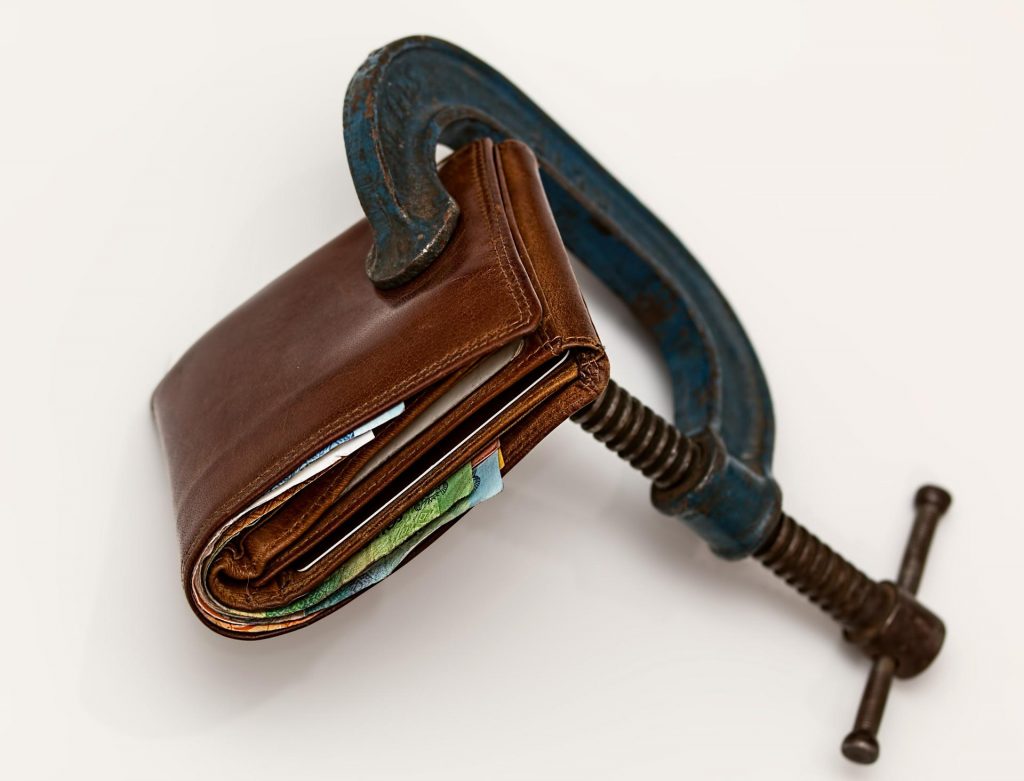
Gradually Save More Money and Pay off Debts
Take it step-by-step if you don’t know how to save money aggressively. You will still need to budget and commit to your goals, but you will find more moderate ways to achieve them.
One method is to increase the amount you save each month. Let’s say you usually save 5% of your income. Try to increase the amount you save by 1% every month for half a year. By the end of the year, you’ll reach 10%. That is a far more significant amount, but the difference won’t seem as intense because it gradually increases. You will have time to adapt to new, more moderate spending habits.
The same strategy can apply to paying off debts. Each month, try to repay more than the minimum rate. This month, pay 1% more. The next one, 2% more, and so on. If you want to pay off debts fast, you can also set priorities. Here are two methods for this:
- The Debt Avalanche
- The Debt Snowball
The debt avalanche
This strategy involves paying debt with the highest interest rate first. From a mathematical point of view, it is the best solution to pay off debts because it will help you save money on interest. Loans are overwhelming and often come with hefty interest rates. Over time, you might spend thousands of dollars repaying a high-interest loan. The sooner you pay off debt, the less interest you will have to pay.
Make minimum payments for all other debts every month, but aim to pay more for the debt with the highest interest. Put aside all the extra cash you can get and use it to tackle the first debt as fast as possible. Then, move on to the next high-interest debt until you’ve paid them all off. Despite its efficiency, the avalanche method is not always feasible. For most people, repaying these loans can take years.
The snowball method
This method uses a different approach than the Avalanche Method. It also involves making minimum monthly payments toward every debt but focusing on your smallest loan. Repay this debt as quickly as possible by concentrating all your extra money on it and repeat this process as you continue to pay off debts.
The snowball method aims to make debts disappear faster because you feel motivated to continue seeing your debts vanish one by one. It doesn’t address high-interest rates, but the positive effect of paying off debts rapidly should keep you from feeling overwhelmed by your debt. It also keeps you committed to your financial goals.
Here is an example of how this method works:
The Snowball Method – A 4-Step Debt Repayment Strategy | |
Step 1 | List every debt you owe from smallest to largest |
Step 2 | Make minimum payments on all except for the smallest debt |
Step 3 | Focus on and pay as much towards your smallest debt as possible |
Step 4 | When one is paid, move on to the next smallest debt |
The advantages of the snowball method
With this method, you can become debt-free faster as you’ll see your debts gradually vanish. Focusing on achievable goals, such as paying off small debts first, is an excellent strategy to pursue your biggest aim, being debt-free.
This method is ideal and easier to apply if you’re overwhelmed by many debts. If you choose the avalanche method, paying the debt with the highest interest rate can take a while. Meanwhile, you will continue to have small debts on your expense list, continuing to gain interest. You won’t see progress quickly, and your motivation will likely decrease. The snowball method helps you eliminate the interest you pay on all your small debts, which can add up significantly over time.
If you’re unsure about these methods, you can also try alternatives, such as debt payoff strategies.
What Are the Most Common Debt Payoff Strategies?
There are different ways to reduce your debt. Do your research and ponder each. Don’t make an impulse decision that you might regret later. Instead, find the solution that best suits you. It would:
- Allow you to repay a smaller debt.
- Meet the rest of your financial goals.
- Avoid ruining your credit score.
Three strategies to help you achieve these goals are:
1. Debt Settlement
Debt settlement involves negotiation. It is helpful if you cannot afford to pay your creditors as per the current terms. As a result, try to settle your debt and pay less. There are many debt settlement services that can help you out. You might consider using one of them.
Negotiating with lenders on your own is not easy, but this option may work if you are overwhelmed by debt. If you choose a debt settlement service, you will continue to make monthly payments, but not to your creditors. The company will put the money into a separate account and renegotiate your debt’s terms with creditors. After reaching an agreement, they will start repaying creditors using that account.
You must be aware of a caveat if you decide to use debt settlement companies. They charge money, as you might expect. These people don’t work for free. Although they can help you lower your debt, you have to pay their service fee, so you should ponder things carefully. First, see how much the company charges, usually a percentage of your debt. Then, try to understand if paying this fee is worth it.
You could also try to settle your debt on your own. You might be able to reach a favorable agreement without paying anyone a service fee.
2. Debt Consolidation
Debt consolidation comes down to combining several debts into a single new loan. With this money, you start repaying all the other ones. The aim is to have a single monthly debt bill, which can be more efficient and less burdensome than paying several. Through debt consolidation, you could also reduce your interest rate. Debt consolidation is a good idea for those struggling with multiple loans. It is a more practical solution. You take care of all your debts through a single payment and avoid penalties.
3. Refinancing
This method enables you to replace or refinance your loan. Instead of your current loan, you get a new one covering it. The goal is to have a lower interest rate on the new loan. Other terms might also apply to your new loan, which can also be more favorable. For example, you can get lower monthly payments or find a loan with lower penalty fees.
This method can have its downsides too. First, you must do your research thoroughly because not all refinancing solutions benefit you. It is only helpful to choose a refinance loan if you’re sure it leaves extra cash in your account. Do your best to use that money to pay off your debt. If refinancing leads to additional debt, applying for such a loan doesn’t make sense.