

Last Updated on September 13, 2022
Find Out If Lowering the Thermostat Will Save You Money
Financially, winter is not the best time of the year. During the winter, it seems like you are spending more on everything. From electricity to gas, there are all sorts of expenses that drain you financially.
One of them is heating. Keeping your house warm doesn’t come cheap, especially if it’s big. You might want to start cutting down costs by reducing consumption. Does lowering the thermostat help you save money? Let’s find out.
Does Lowering the Thermostat Save Money in Winter?
We’ve got good news. Lowering the thermostat does lower your electricity bill. The higher the temperature, the more energy the heating system uses to keep the house warm. This is why keeping a lower temperature helps save money. Yet, there are plenty of things to consider.
You might not see a huge difference in your monthly bill by lowering your thermostat. There are different reasons behind this. One is commitment. If your goal is to save money on electricity by lowering your thermostat, stick to it. You have to do this on a regular basis. Reducing the temperature once or twice per week may not save you lots of money.
You also have to choose an ideal temperature level and stick to it. Be consistent. If you want to lower the temperature by five degrees, do it and keep it there. Don’t switch it back to a higher temperature on the first colder day. Being consistent can help you achieve your savings goal.
What Factors Influence How Much Money You Spend on Heating?
Keep in mind that your home temperature will depend on a variety of factors. Even if you turn the heating on, your house might not warm up as fast as you expect. Also, it might feel too cold when you lower the thermostat by 2-3 degrees. This can be the result of poor insulation.
Some of the main factors that influence your heating system’s consumption include:
- The size of the house.
- The quality of the insulation.
- How and where the house is positioned.
- The materials your house is made from.
All these factors influence energy consumption. For example, a house that’s oriented toward the sun for many hours a day uses less energy. That is because direct exposure to sunlight makes the walls warmer.
On the contrary, houses with limited exposure to the sun need more heating. If there are also trees or shrubs surrounding the house, it needs even more heat. These provide shade and prevent the sun from warming up the walls.
A house that has good insulation is one that saves money on energy bills. In winter, it preserves the heat better. In summer, it prevents the heat from penetrating the house’s walls. You can insulate your home with a variety of materials nowadays. Some examples include cellulose insulation, spray foam insulation, polystyrene, fiberglass, and mineral wool.
It is essential to check your doors and windows. You might have good wall insulation, but lose heat anyway. Poorly sealed doors and windows can drain money from your budget. Make sure they all close tightly before you turn the heating system on. To sum up, the three main house-related aspects you should consider to be able to save money on heating include
- The characteristics of your home.
- Where it is located.
- Its surroundings.
How Much Money Can You Save By Lowering the Thermostat?
There is no standard answer or one-size-fits-all solution here. We’ve already highlighted that keeping your house warm depends on a multitude of factors. That is why you must test your thermostat to come up with an answer.
By experimenting with different temperatures, you will find the right one. The right temperature is one that allows you to feel comfortable. All the while, it helps you lower your energy bill.
The recommended temperature for households is 68 degrees Fahrenheit. That is a temperature that allows you to feel comfortable, or at least it should. It is also a matter of habit. If you’re used to a constant temperature of 73-75 degrees, 68 degrees might feel too cold. In this case, you don’t have to lower the temperature from one day to the next.
Start with two degrees at a time. Lower the thermostat step by step over several days or even weeks. This will allow your body time to adapt. Once you get to 68 degrees, maintain this temperature. Then, monitor your energy usage. Does your bill indicate you’re using less? If the difference is significant, it may be worth making the adjustment.
Does lowering the thermostat save money quickly? The answer is no, unless you’re making a big temperature shift. That can decrease your comfort level, so it’s better to take things slowly.
The US Department of Energy says you can save 5 to 15% on your bills by making temperature adjustments. This applies to changes of 10 to 15 degrees, which may not be easy to get used to. Also, the temperatures should be maintained at a lower level for at least eight hours at a time to save money.
Here is a quick example of how much money you could save:
Current temperature | New temperature | Current monthly bill | Money saved per month | Money saved per year |
73 degrees Fahrenheit | 68 degrees Fahrenheit | $150 | $15 | $180 |
To adapt to this formula, you need to plan. When is the right time to lower the temperature? You could do it while everyone is away at work or school. That accounts for several hours in a row, hopefully at least eight. If you work from home, it may be uncomfortable. Another solution is to lower the temperature at night.
It is even recommended to sleep at lower temperatures. In theory, the ideal temperature for sleeping is between 60 and 67 degrees. This means you could keep the thermostat to a lower level at night. You could save around 3% of your energy bill for every one degree you lower the thermostat.
Let’s imagine you only lower the thermostat by 1-2 degrees. Here are the savings you can achieve for the same $150 bill example:
Current temperature | New temperature | Current bill | Money saved per month | Money saved per year |
73 degrees Fahrenheit | 72 degrees Fahrenheit | $150 | 3%: $4.5 | $54 |
71 degrees Fahrenheit | $150 | 6%: $9 | $108 |
How to Keep a Good Level of Comfort While Lowering the Temperature
It’s only natural to be a bit worried when you plan on lowering your thermostat. Who wants to live in a house where they don’t feel comfortable? Yet, there are many solutions to feel comfortable while lowering the thermostat temperature. You don’t have to compromise comfort to spend less on electricity bills. Here are a few tips:
- Dress properly.
- Use the right blankets.
- Insulate your home indoors.
How you dress indoors plays a major role in how much you spend on heating. You might like wearing T-shirts all year round at home. That is comfortable, but not cost-effective. Wear a warm, large sweater instead and always wear socks. These two tiny changes can make a huge difference. You will feel less cold, so you’ll be able to lower the thermostat.
The same principle applies to your house. You might be used to a shiny, clean, and clear floor. Who needs carpets anyway? They only gather dust. Yet, in the winter, carpets and rugs are very effective. If you don’t have heated floors, it makes sense to use rugs to insulate your floor.
You won’t feel cold each time you stand or walk on the floor. As a result, you’ll feel comfortable lowering the thermostat. You don’t have to cover the whole floor with carpets, just place them on strategic points such as
- Under your desk
- Under the table
- In front of the couch, bed, or armchairs
These are the places where you sit, so your feet are on the floor. Make sure you keep them warm.
Try to adapt to winter temperatures in your sleep, literally. Use warmer clothes as well as thicker blankets. These will prevent you from feeling the slightest difference after lowering the thermostat. You will enjoy the same restful sleep, if not better.
Setting Your Thermostat to Save Money
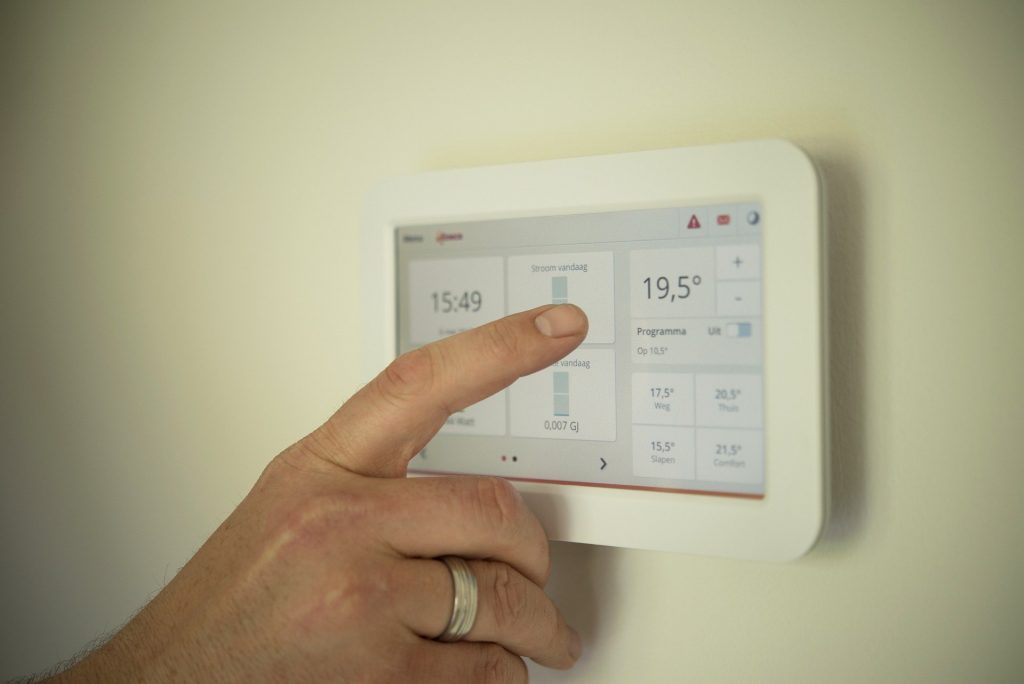
Now you know how much you can save by lowering your thermostat. You also know the ideal temperature for day and night. How about making quick adjustments to your thermostat?
For example, you might be away on holiday for two weeks. Your heating system is off the entire time. When you get home, it’s cold, and you want to heat the house as fast as possible to feel comfortable.
Will setting the thermostat to a high temperature help? The answer is no. It will only consume more energy. The furnaces have a strict operating mode. They produce heat at the same rate. Increasing the temperature a lot won’t make a difference. You will still have to wait to feel warm.
The same logic applies when switching from night to day temperat